


Still in Egypt: When Freedom Has Not Reached the Mind
- Rodney K. Spears

- Jul 20
- 4 min read
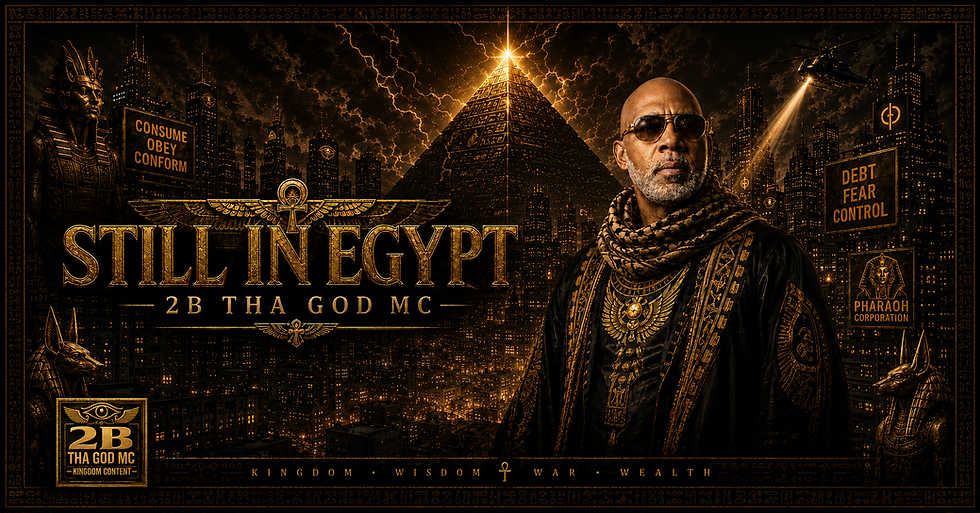
Black-and-gold promotional artwork for Still in Egypt by 2B Tha God MC, the music and teaching identity of Rodney K. Spears. The image combines ancient Egyptian symbolism with a modern city controlled by fear, debt, conformity, and power, illustrating how physical freedom does not always produce freedom of the mind. https://www.rodneykspears.com/still-in-egypt-2b-tha-god-mc
Still in Egypt: When Freedom Has Not Reached the Mind
The Israelites left Egypt in a single night, but Egypt did not immediately leave them.
Their chains were broken. Their taskmasters were gone. The Red Sea had closed behind them. Yet when difficulty appeared, many of them still thought like slaves. They feared the future, distrusted God, resisted responsibility, and longed for the familiar bondage they had once prayed to escape.
That is the central message of Still in Egypt.
Egypt is more than a location in the biblical story. It represents a system of bondage that controls people through fear, dependency, pressure, false security, and distorted identity. A person can leave the place of captivity while continuing to carry its thinking, habits, and expectations.
You can be physically free and still mentally bound.
You can change your environment without changing your identity.
You can leave an oppressive relationship, workplace, lifestyle, or belief system while continuing to make decisions from the fear it produced.
Modern Egypt Does Not Always Look Ancient
Today, Egypt may not appear as brick-making fields under Pharaoh. It may appear as debt that controls every decision, fear that prevents obedience, consumerism that defines personal worth, or cultural pressure that commands people to consume, obey, and conform. Modern bondage often presents itself as security.
It tells people not to question the system because the system provides food. It teaches them to fear freedom because freedom requires responsibility. It convinces them that survival is the highest goal, even when God has called them to purpose, stewardship, maturity, and dominion.
The signs may have changed, but the message remains familiar:
Consume.
Obey.
Conform.
Remain afraid.
Stay dependent.
Do not recognize who God created you to be.
The Slave Mentality
A slave mentality is not simply a negative attitude. It is a way of seeing yourself, God, responsibility, authority, and the future.
It expects someone else to provide everything.
It fears making decisions.
It resists accountability.
It prefers familiar captivity over uncertain growth.
It interprets challenges as evidence that freedom was a mistake.
When the Israelites faced hunger, thirst, opposition, and uncertainty, many began romanticizing Egypt. They remembered the food but forgot the oppression. They remembered the familiarity but forgot the cries that had risen to God.
Bondage often becomes attractive when freedom becomes difficult.
That is why leaving Egypt is only the beginning. The mind must also be renewed.
God Did Not Deliver Israel Merely to Wander
God brought Israel out of Egypt because He intended to bring them into covenant, identity, responsibility, and inheritance.
They were not delivered only from Pharaoh. They were delivered to become a people who represented God in the earth.
Freedom was not the final destination. It was the doorway into formation.
In the wilderness, God taught them how to trust Him, govern themselves, steward resources, live in community, honor covenant, and walk according to His order. The wilderness exposed the ways Egypt had shaped their thinking.
In the same way, God may deliver a person quickly while transforming that person gradually.
The chains may fall in a moment, but learning to live free requires faith, obedience, healing, truth, discipline, and renewed identity.
The Question Is Not Only, “Did You Leave Egypt?”
The deeper question is:
Did Egypt leave you?
Do you still make decisions through fear?
Do you believe you are powerless without the system that once controlled you?
Do you resist responsibility while praying for greater authority?
Do you confuse dependency with humility?
Do you desire promise while rejecting the process required to possess it?
God does not free His people so they can remain emotionally, mentally, financially, or spiritually dependent upon the structures that enslaved them.
He brings them out so they can become sons and daughters who understand their identity, carry responsibility, build wisely, and represent His character.
From Captivity to Dominion
The movement from Egypt to dominion begins with truth.
You must identify the beliefs that bondage taught you.
You must recognize where fear has been governing your choices.
You must stop calling captivity security.
You must allow God to redefine who you are.
You are not merely a survivor of Egypt. You are an image-bearer of God.
You were created to reflect His character, steward what He places in your hands, develop what He entrusts to you, and walk in covenant responsibility. Dominion is not domination or control over others. It is mature stewardship under the authority of God.
The journey out of Egypt is therefore not only about escaping something. It is about becoming someone.
Still in Egypt
Still in Egypt challenges listeners and readers to examine the invisible systems that continue to shape their lives. It confronts fear, dependency, debt, conformity, false identity, and the desire to return to familiar bondage.
The message is not condemnation. It is an invitation.
God did not bring you out so you could remain trapped in the thinking of the place you left.
He brought you out to renew your mind, restore your identity, establish covenant, teach you stewardship, and prepare you to walk in purpose.
You may have left Egypt.


Comments